
Resume Photo in Germany: Required or Not?
No German employer can make you send a photo, yet many still expect one. When a photo helps, when to leave it out, and what a good one looks like.
The legal side first. Since the General Equal Treatment Act (AGG) came into force in 2006, employers in Germany avoid asking for a photo, because such a request can be read as a sign of discrimination. You never have to include one. In practice, many industries still expect a photo, and a German CV with a good photo often looks more complete.
When a photo makes sense
- Usually with a photo: traditional German Mittelstand companies, banks and insurers, client-facing roles, hotels and restaurants. This covers most employers who follow the conservative German application standard.
- Usually without: international companies and startups that hire in English (some ask you not to send a photo), anonymised application processes, and any ad that asks for no photo.
- Applications through an ATS: the software ignores photos. A photo placed cleanly in the PDF does no harm either.
The choice is yours. Be consistent: a professional photo or none at all. Never a holiday picture, a selfie or a portrait from ten years ago.
What a good application photo looks like
- Taken by a photographer or in studio quality, with a plain background, soft light and a sharp image.
- Recent (no more than about two years old), in clothes that suit the industry you apply to.
- A friendly, professional expression, looking into the camera.
- Placed at the top right of the CV or on a cover page. Use one of the two places only, and never put the photo in the cover letter.
How Zusaga helps
In Zusaga you switch the photo on or off for each design. Click Design in the resume editor to see them. Lebenslauf Deutschland, BA Klassisch and BA Modern each have a Show photo checkbox. ATS single column never shows a photo, because it would get in the parser’s way.
You add your photo once, with Add photo in the Contact information section of the resume editor. It then appears in every design that has Show photo ticked.
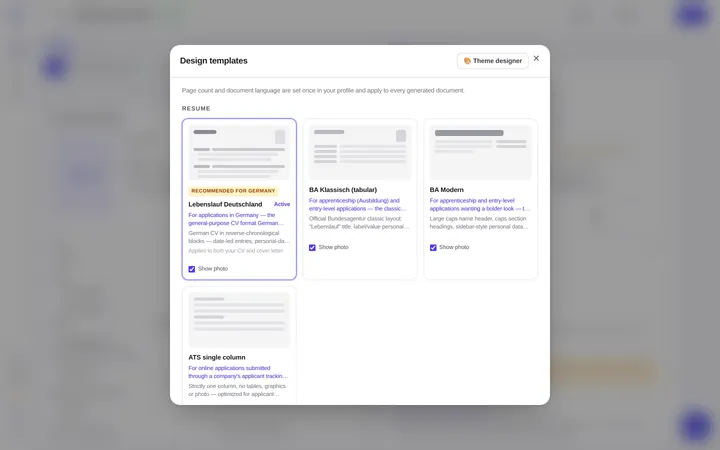
When a company asks for applications without a photo, you untick Show photo and the layout stays as it is. All designs are free. If you are still deciding how much to put on the page, read our guide to resume length in Germany.