
Explaining Resume Gaps in Germany, Honestly
When a gap in your CV needs explaining on the German job market, how to name it in one line, and why hiding it is the only real mistake.
Not every pause is a gap. A break of up to two months, for example between leaving one job and starting the next, needs no explanation. A gap is worth addressing once several months pass without an entry. Even then, a gap you explain well will not cost you an interview. A gap you hide can.
The one real mistake is hiding it
German recruiters read timelines closely. In Germany you usually get a written reference (Arbeitszeugnis) with exact dates from every employer, so dates are easy to check. Stretching dates (“2022–2023” instead of “11/2022–01/2023”) or moving a job to other dates turns a harmless pause into a question of trust. German employers react strongly to that. The German standard also expects month and year for every date (MM/YYYY). A CV with years only already looks as if it hides something.
Name the gap in one line
Give the time a name in your CV, like any other entry:
- Further training or retraining: “03/2023–08/2023 Data analytics course (certificate XYZ)”. This is the strongest explanation when it is true.
- Family time or care: “Parental leave” (Elternzeit) or “Caring for a family member”. Keep it factual and leave out details. In Germany this is normal and is read as normal.
- Illness: “Career break for health reasons, fully recovered”. Never name a diagnosis. The last part of the line is the one that matters.
- Job search after a layoff: “Career reorientation”, plus what you did in that time, such as courses, projects or volunteering.
Write it without apology. Words like “unfortunately” or “I had to” make a normal break sound like a problem.
In the letter and the interview
Mention a gap in the cover letter only if it is long and the ad gives you a reason. Use one sentence that looks forward: what you took from that time, not what you regret. Put your fit for the role first and the gap second, and never open the letter with it. In the interview, do the same: name the gap briefly, give the context and come back to what you offer. If you practise three sentences, you will not be caught off guard.
How Zusaga helps
Zusaga’s resume analysis reads your timeline the way a recruiter does. It checks that your entries run from newest to oldest, that every date has a month and a year, and that no gap longer than two months is left without an explanation. Each problem becomes a concrete finding on the field it concerns.
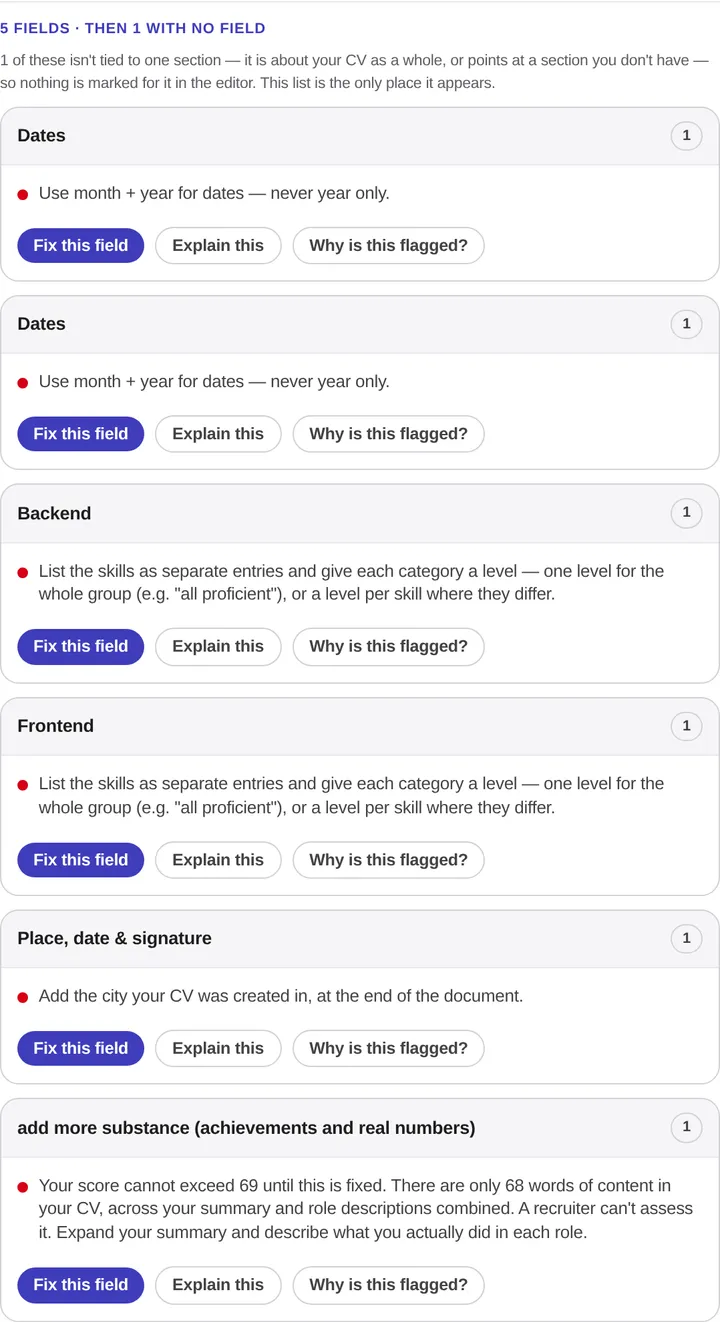
The free evaluation shows your score and your two most important findings once a week. With Zusaga Pro, Start fixing takes you through every finding step by step, and the coach suggests wording that uses only facts from your resume. For the right date format and layout, see our guide to the ATS-friendly resume.