
Salary Expectations in a German Cover Letter
German job ads often ask for your Gehaltsvorstellung. How to choose the figure, where it goes in the letter, and sentences you can copy.
Many German job ads ask you to state your Gehaltsvorstellung, your expected salary, in the application itself. Recruiters mean it. If the ad asks and your letter says nothing, your application can be treated as incomplete.
Choose the figure first
- Know your market value. Look at salary reports for your role, industry and region. Munich pays differently from Magdeburg.
- Use the gross annual salary. In Germany you always state the yearly gross figure (brutto), including all fixed parts of the pay.
- Name one figure. Pick a number at the upper end of what is realistic for you. If you give a range, keep it narrow, about 5 % either side, because the reader remembers the lower end.
- Make it precise. 62,500 € reads as a figure you worked out. 60,000 € reads as a guess.
Where it goes
Put it at the end of the cover letter, in the last paragraph before the closing. First you show why you fit the role, then you name your price.
Sentences you can use
“Meine Gehaltsvorstellung beträgt 62.500 Euro brutto im Jahr.” (My salary expectation is €62,500 gross per year.)
“Meine Gehaltsvorstellung liegt bei 62.500 Euro brutto jährlich. Über die Einzelheiten spreche ich gern im persönlichen Gespräch.” (My salary expectation is €62,500 gross per year. I am happy to discuss the details in an interview.)
If you would rather not name a figure yet, you can put it off politely:
“Eine konkrete Spanne nenne ich gerne, sobald ich die Aufgaben genauer kenne.” (I will gladly name a concrete range once I know the tasks in more detail.)
This is weaker than a figure, but it answers the question. Leave out apologies (“I hope this is not too much”), the word “negotiable” without a number, your current salary, and conditions attached to the figure. Each of these weakens your position.
If the ad does not ask
Then leave salary out of the letter. A figure nobody asked for gives away room to negotiate before the company knows what you bring.
How Zusaga helps
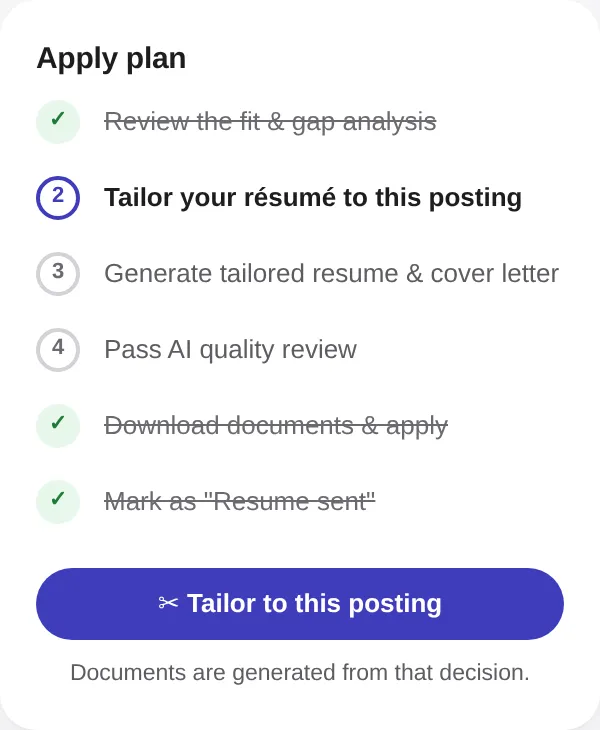
Zusaga writes a cover letter for each job from your tailored resume, in the German DIN 5008 letter format. The Apply plan on every job page shows the order: you tailor your resume to the posting first, then Zusaga writes the resume and the letter.
The letter editor has a Salary & start date section. When the ad asks for a salary, tick The posting asks for a salary expectation there, and the letter states your figure in its last paragraph. With I’d rather name a range later ticked as well, it uses the polite sentence above instead of a figure. If the posting does not ask, the letter does not mention salary.
You enter your salary expectation, your earliest start date and your notice period once, in your Application profile. Every new letter starts with them filled in. If you change them in the letter editor and click Save, your Application profile is updated too.
Cover letters are part of Zusaga Pro. For the layout of the whole letter, read our guide to the DIN 5008 cover letter format.